Camouflage Masters: The Antelopes You Hardly Ever See in South Africa
If you’ve been on safari a few times, you probably feel you’ve “done” the antelopes: impala everywhere, kudu posing perfectly on hillsides, maybe even a shy bushbuck if you were patient. But (South) Africa has a whole lineup of antelopes that almost never make it into holiday albums: not because they’re not there, but because they’re absolute escape artists.
Some of them are the size of border collies, some look exactly like stones, and some you only notice because a tail flicks once and then vanishes again. This is a little story about those antelopes: the ones you rarely see, even when they’re standing right in front of you.
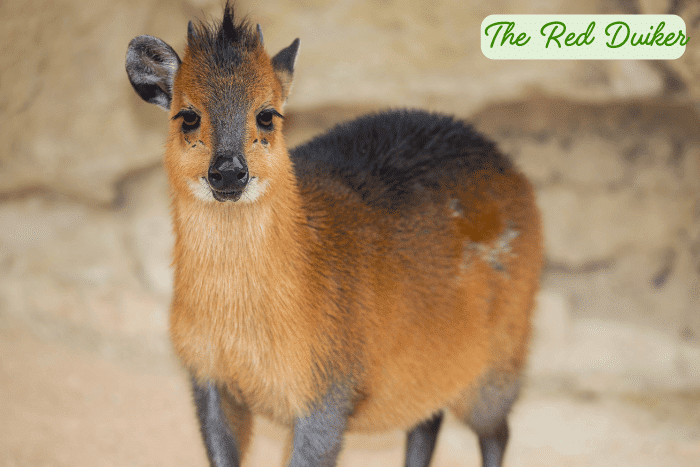
The Red Duiker & the Suni: The Forest Ghosts
If you ever walk in the coastal forests of KwaZulu-Natal, you know the feeling: something rustles, you stop, and the whole forest holds its breath. Most people assume it’s a monkey or a bird. But often, it’s one of the forest specialists: the red duiker or the tiny suni.
They move like shadows. One second they’re there, the next they’ve disappeared behind a single leaf. They’re actually diurnal, which makes their “vanishing act” even more impressive.
Places like iSimangaliso and the quieter corners of Hluhluwe are your best chance, but even then, it’s usually just a glimpse of rusty fur sliding between patches of sunlight.
A little anecdote from me: I once spent 20 minutes convinced I was photographing a rare bird in the undergrowth because something orange kept slipping between the branches. Only when I checked the photos later did I realise it was a red duiker’s backside politely disappearing every single time.
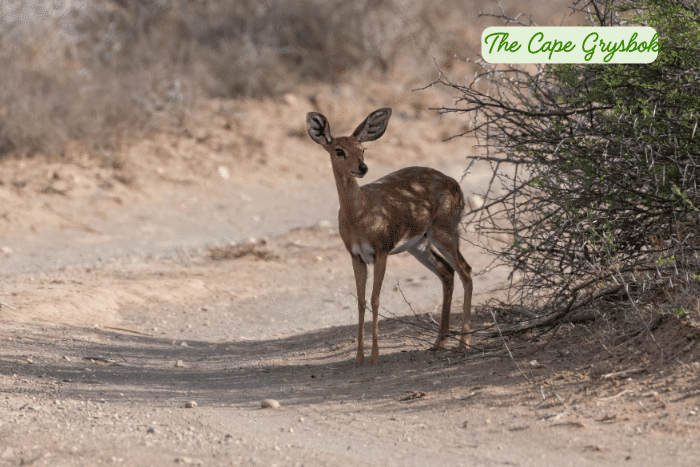
The Cape Grysbok: The Antelope That Pretends to Be a Rock
The Cape grysbok is the kind of animal that would win a hide-and-seek championship without even trying. Its name even gives it away: grys means “grey”, and the Cape grysbok has perfected the exact shade of South African rocks and scrub.
They freeze the second they feel spotted. And once they freeze, good luck. You’ll stare at a bush for a long time thinking, “Is that…? No, it’s a rock.” And then the “rock” suddenly leaps away on tiny legs.
You can find them in the fynbos regions and along the Western Cape coast, but only if your eyes are trained for “rock-ish shapes that might secretly breathe.”
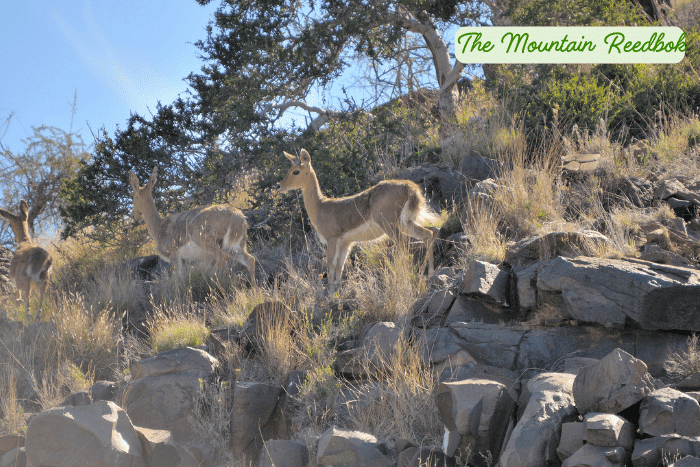
The Mountain Reedbuck: Master of the Drakensberg Disappearing Act
There’s something special about spotting a mountain reedbuck; mostly because you often don’t realise you’ve spotted one until it moves. Their tawny-grey coats match the slopes of the Drakensberg so well that even seasoned guides sometimes miss them.
You’ll be scanning a ridge for eagles or baboons, and suddenly a head pops up from behind a boulder, watches you politely, and then melts back into the scenery.
Mountain reedbuck live high up, far from crowds and most safari routes. But if you ever hike in the Berg at dawn or late afternoon, keep your eyes soft instead of focused: that’s often when they reveal themselves.
The Oribi: The Grassland Minimalist
The oribi is delicate, almost dainty, and lives in open grasslands where, in theory, you’d think spotting it would be easy. But it’s not. They’re timid, scarce, and their entire survival strategy seems to be “keep a low profile and vanish politely.”
If you see anything, it’s usually a tiny black tail flick far ahead in the grass, and by the time you raise your binoculars, the oribi is already a rumour.
They’re more threatened than many people realise, because grassland habitats are disappearing fast. Parks in KwaZulu-Natal, parts of Mpumalanga, and some private reserves still protect them, but even there they keep their distance.
Conclusion
These shy antelopes may not dominate safari brochures, but they add a whole extra layer to South Africa’s landscapes. Have you ever spotted one of them, or think you might have? Let me know in the comments below.
Who am I? Well, the least you can say is that I am quite crazy about Africa, its nature, its climate, its culture, and more.
As a young woman in my twenties, I had already traveled to several African countries by traveling along in an overlander on my own and mostly camping ( or glamping ) and just fell in love with the diversity of it all.
So much, so that at the age of 26, I went back to university to study biology, which, unfortunately, I couldn’t finish because of health reasons (yes, I got sick from a tropical disease, oh cynicism). But this did not stop my dream of traveling back to Africa several times, and I still do.
My dream was back then to leave Europe and go study animal behavior, especially the elephants (sure, that’s every girl’s dream haha), but I am also very much intrigued by hyenas and other “ugly African animals“.
So, I “kind of” have a little bit of a scientific approach to my articles, when I write about African birds, for example. And most of all: the passion.
But life goes on, you move from one side of the country to the other, you get sick again and top it off with lower back problems, and before you know it, you are over 50 hahaha!
Now, I still travel to Africa, but take it a bit “easier” than the good old camping days, and stay in comfortable, yet affordable accommodations, together with my husband Wouter.
These are some of the countries I have traveled to: Kenya, Tanzania, Zanzibar, Malawi, Zambia, Zimbabwe, South Africa, Namibia, Botswana, Tunisia, and a little bit of Lesotho LOL .
While clearly not being African territory, but Spanish, I also visited Gran Canaria and Tenerife, and location-wise, I consider them “African”, because of their climate and nature, sue me :-p
The last trip I took was to South Africa in the year 2023, and it sure got the fevers for Africa back! From the Barberton mountains to the Drakensberg and the Southcoast, one month wasn’t enough at all to see the whole country, so we’ll be back! At ease and with a little bit more luxury than in my younger days haha!