One of the things that always fascinates me on safari isn’t just the animals themselves, but the details you only notice after spending a lot of time out there. For me, horns are one of those details. Some antelopes have modest little curves. Others… well, some walk around with architecture on their heads.
When it comes to sheer horn length, the greater kudu stands firmly at the top. Mature males grow spirals reaching 1.5–1.8 metres, making them the longest horns of any African antelope. What’s even more impressive is that the length doesn’t come from a straight line: it’s measured along the curve, following those two-and-a-half twists. If they were pulled straight, the horns would be even longer.
Kudu bulls only start growing these dramatic spirals at around six to twelve months old, and the full twist can take years to develop. Older bulls often have thicker, heavier horns with deeper ridges, and you can almost tell their age by how complete the spirals look.
When one steps into an open clearing, it’s hard not to feel a bit of awe: they look like they’ve walked straight out of an ancient story.
As beautiful as they are, the horns aren’t just decoration. Male kudus lean into each other during the rut, pushing and twisting in these slow, deliberate strength contests. It’s not the dramatic clashing you see with some species; most of the time, it looks almost respectful, as if both bulls understand the goal is to decide dominance, not cause injury.
But the spirals don’t always behave. Because they curve so deeply, two bulls can occasionally lock their horns together and simply can’t untangle again. Rangers sometimes find them side-by-side, both lost because the duel went wrong. It’s rare, but it stays with you the first time you hear about it.
Other African Antelopes With Serious Horn Length
Kudus may hold the record, but several other antelope species also carry extraordinary horns.
Gemsbok (oryx)
Whenever I see a gemsbok, I understand immediately why predators hesitate. Their long, straight horns, often more than a metre, act like precision weapons. There are documented cases of lions being injured in confrontations, which tells you everything about how seriously gemsbok take self-defence.
Sable and Roan Antelope
Sable bulls, with their long backward-arching horns, are stunning in a completely different way. Their horns can reach over a metre too, and they use them in powerful upward swings if they’re threatened.
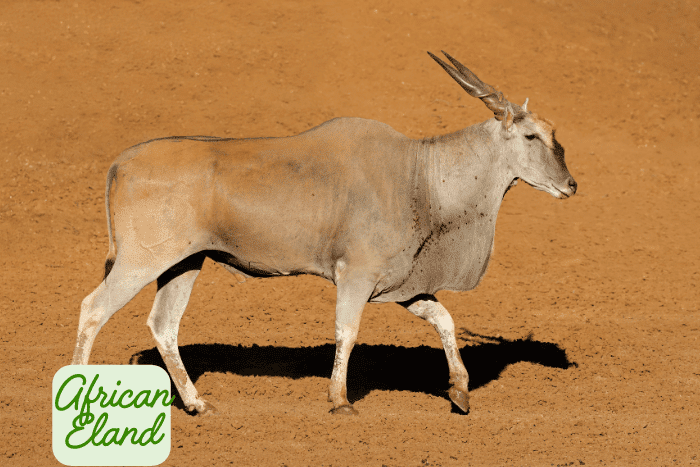
Eland
They don’t win in length, but they win in mass. Two big males testing each other is like watching heavyweight wrestlers: slow, powerful, and surprisingly controlled.
A Detail I Never Noticed Until Someone Told Me
All these antelopes keep their horns for life. They don’t shed them like deer. Once the horns start growing, that’s it: every chip or ridge becomes part of the animal permanently. There’s something almost endearing about that: each set of horns feels like a biography written in bone and keratin.
Now you know who has the longest horn in Africa, I hope you will enjoy your safari even more!
Who am I? Well, the least you can say is that I am quite crazy about Africa, its nature, its climate, its culture, and more.
As a young woman in my twenties, I had already traveled to several African countries by traveling along in an overlander on my own and mostly camping ( or glamping ) and just fell in love with the diversity of it all.
So much, so that at the age of 26, I went back to university to study biology, which, unfortunately, I couldn’t finish because of health reasons (yes, I got sick from a tropical disease, oh cynicism). But this did not stop my dream of traveling back to Africa several times, and I still do.
My dream was back then to leave Europe and go study animal behavior, especially the elephants (sure, that’s every girl’s dream haha), but I am also very much intrigued by hyenas and other “ugly African animals“.
So, I “kind of” have a little bit of a scientific approach to my articles, when I write about African birds, for example. And most of all: the passion.
But life goes on, you move from one side of the country to the other, you get sick again and top it off with lower back problems, and before you know it, you are over 50 hahaha!
Now, I still travel to Africa, but take it a bit “easier” than the good old camping days, and stay in comfortable, yet affordable accommodations, together with my husband Wouter.
These are some of the countries I have traveled to: Kenya, Tanzania, Zanzibar, Malawi, Zambia, Zimbabwe, South Africa, Namibia, Botswana, Tunisia, and a little bit of Lesotho LOL .
While clearly not being African territory, but Spanish, I also visited Gran Canaria and Tenerife, and location-wise, I consider them “African”, because of their climate and nature, sue me :-p
The last trip I took was to South Africa in the year 2023, and it sure got the fevers for Africa back! From the Barberton mountains to the Drakensberg and the Southcoast, one month wasn’t enough at all to see the whole country, so we’ll be back! At ease and with a little bit more luxury than in my younger days haha!