White Lions: Africa’s Rare “Ghosts” of the Savannah
The first time I saw a white lion on video, I honestly thought it had to be edited. Lions are normally golden brown, so seeing one that looks almost white immediately feels strange. But they really exist, and they are one of the rarest things you can ever see on safari.
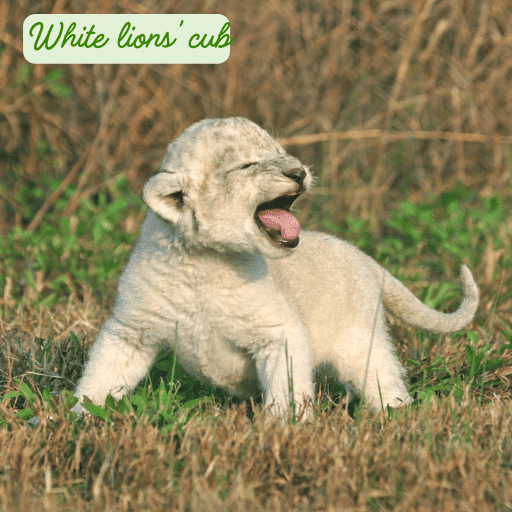
The video I’m sharing with the white lion cub here shows exactly why people get so excited about them. It’s not something you come across often, even if you travel through Africa a lot.
What Makes White Lions So Special?
White lions are not albinos. They are normal African lions with a rare genetic trait called leucism.
Leucism is a genetic condition that affects how pigment cells develop in an animal’s body. Because of this, the animal shows partial or complete loss of color in its fur, feathers, or skin, but the eyes remain their normal color.
It differs from albinism, where pigment production is completely absent, and the eyes are usually red or pink.
Two normal tawny lions can carry this gene without anyone noticing. Then one day, a white cub is born. That’s why white lions appear so suddenly and unpredictably.
Where Do White Lions Still Live Today?
White lions come from one specific area: the Timbavati region, right next to Kruger National Park in South Africa. Years ago, many were taken out of the wild for zoos or killed because of their rare color. By the 1990s, there were no white lions left living freely in nature.
In the early 2000s, white cubs started being born again in Timbavati. The gene had survived inside the local lion population. Today, a very small number of white lions once again roam between Timbavati and Kruger.
We’re not talking about dozens; there are only about four or five white lions in the wild at any time.
I’ve only ever spoken to one tourist on a safari near Kruger, who saw a white lion in the wild. She still talks about it years later because she knows how lucky that sighting was.
How Do They Survive in the Wild?
White lions live inside normal lion prides. They grow up with golden-colored brothers and sisters and hunt together like any other lions.
They don’t live separately, and they are not treated differently inside the pride. Their survival depends on the same things as any other lion: territory, teamwork, and access to prey.
The Cultural Meaning of White Lions
In the Timbavati area, white lions have always had a special meaning. Local communities see them as rare and important animals. Some traditions describe them as messengers or signs connected to the land.
Whether you believe in that or not, people in the region have respected these lions for generations.
Why Seeing One Is So Rare
Most safari travelers will never see a white lion. Even guides who work in Kruger for years may only see one once, if at all.
That’s what makes them so interesting, and I hope you do get to see them one day!
Who am I? Well, the least you can say is that I am quite crazy about Africa, its nature, its climate, its culture, and more.
As a young woman in my twenties, I had already traveled to several African countries by traveling along in an overlander on my own and mostly camping ( or glamping ) and just fell in love with the diversity of it all.
So much, so that at the age of 26, I went back to university to study biology, which, unfortunately, I couldn’t finish because of health reasons (yes, I got sick from a tropical disease, oh cynicism). But this did not stop my dream of traveling back to Africa several times, and I still do.
My dream was back then to leave Europe and go study animal behavior, especially the elephants (sure, that’s every girl’s dream haha), but I am also very much intrigued by hyenas and other “ugly African animals“.
So, I “kind of” have a little bit of a scientific approach to my articles, when I write about African birds, for example. And most of all: the passion.
But life goes on, you move from one side of the country to the other, you get sick again and top it off with lower back problems, and before you know it, you are over 50 hahaha!
Now, I still travel to Africa, but take it a bit “easier” than the good old camping days, and stay in comfortable, yet affordable accommodations, together with my husband Wouter.
These are some of the countries I have traveled to: Kenya, Tanzania, Zanzibar, Malawi, Zambia, Zimbabwe, South Africa, Namibia, Botswana, Tunisia, and a little bit of Lesotho LOL .
While clearly not being African territory, but Spanish, I also visited Gran Canaria and Tenerife, and location-wise, I consider them “African”, because of their climate and nature, sue me :-p
The last trip I took was to South Africa in the year 2023, and it sure got the fevers for Africa back! From the Barberton mountains to the Drakensberg and the Southcoast, one month wasn’t enough at all to see the whole country, so we’ll be back! At ease and with a little bit more luxury than in my younger days haha!