
When I took this photo of a warthog, I immediately noticed what looked like tears running down its face. It was grazing calmly, yet the dark streak beneath its eye made it look almost emotional.
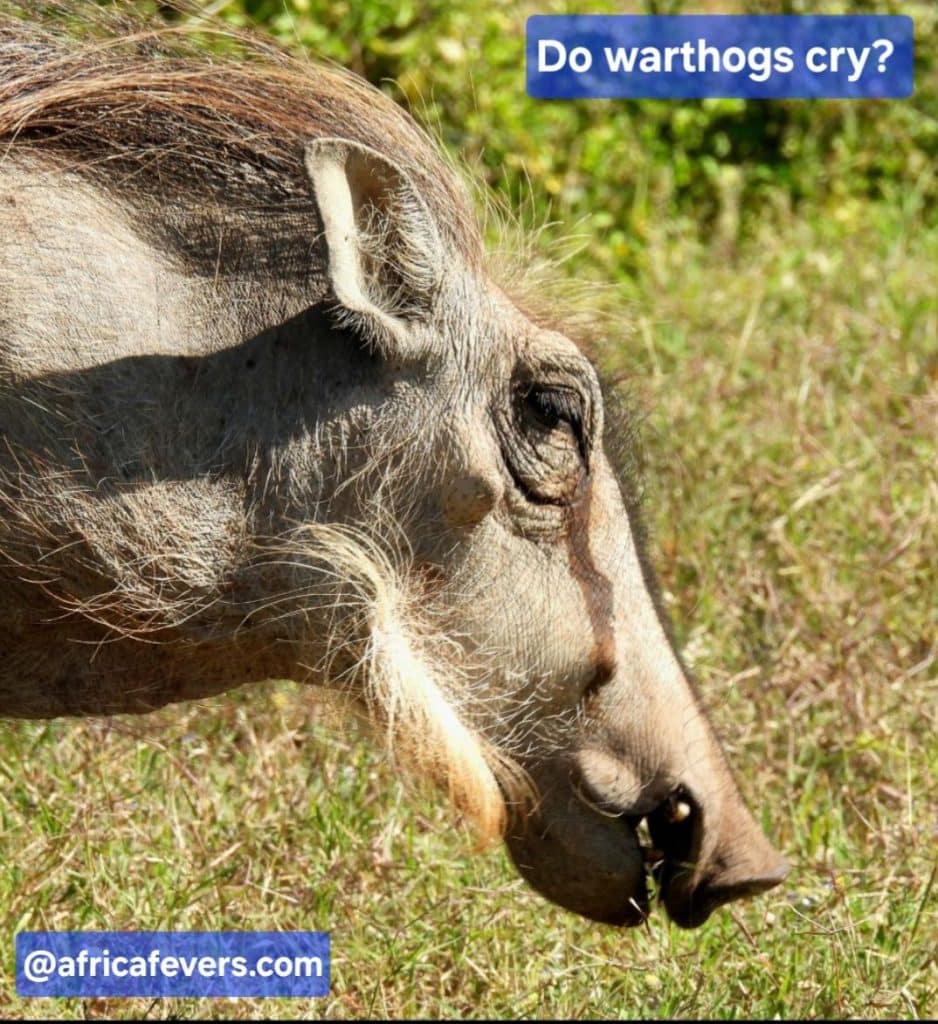
I caught myself wondering the same thing many people do when they see images like this: do warthogs actually cry?
Because this question comes up so often, I decided to look into it properly and separate appearance from biology.
Why warthogs can look like they’re crying
Warthogs do produce tears, just like most mammals. However, these tears are not connected to emotions such as sadness, fear, or distress.
In the wild, tears have a practical function. They keep the eye surface moist, protect against dust and debris, and help flush out irritants.
Warthogs spend much of their day grazing with their heads close to the ground. In dry, grassy savanna environments, this makes eye irritation very common. When the eyes are irritated, tear production increases, and those tears can spill over and become visible.
Seeing the video below, you can imagine how emotional people can get watching a situation like this, auwchh:
Why tear streaks are so visible in warthogs
While researching this topic, I found that warthogs are particularly prone to visible tear tracks because of their anatomy and habitat.
They have very sparse facial hair, so tears are not absorbed and remain visible on the skin. Their tear ducts are relatively short and exposed, which allows moisture to drain onto the face. Deep facial folds and wrinkles then guide the tears downward into clear streaks.
In bright sunlight, especially in open savanna landscapes, these streaks reflect light and become even more noticeable in photographs. It is always a pleasure to me learning more about wildlife photography.
Are these tears a sign of sadness or stress?
No. Warthogs do not cry in an emotional sense.
When they experience stress or danger, they communicate in other ways, such as loud squealing, alarm calls, or sudden movement toward a burrow. Tears are not part of their emotional signaling. What you see in photos like this is a physiological response, not an emotional one.
Their screams, however, are heartbreaking to me:
Why we interpret wildlife faces emotionally
As humans, we are highly sensitive to eyes and facial expressions. Seeing what looks like a tear automatically triggers emotional interpretation, even when none is present.
This effect is especially strong in wildlife photography when the animal is shown at eye level, in profile, and with clear lighting around the eye. The result can feel very personal, even though the animal is simply behaving normally.
Warthogs are not the only animals affected by this misconception. Elephants, primates, and even birds are often described as “crying” when moisture is visible around the eyes. In most cases, the explanation is the same: normal tear production caused by the environment or irritation.

That single photo made me pause, but it also turned into a reminder of how easily we project human emotions onto wildlife.
What do you think?
Have you ever taken a wildlife photo that seemed emotional at first glance? Or seen an animal that appeared to be “crying” in the wild?
I’d love to hear your thoughts and experiences. Feel free to share them in the comments below.
Have a good safari!
Lizzy
I now have a YouTube channel as well!
YouTube
Hello Africa travellers!
Who am I? Well, the least you can say is that I am quite crazy about Africa, its nature, its climate, its culture, and more.
As a young woman in my twenties, I had already traveled to several African countries by traveling along in an overlander on my own and mostly camping ( or glamping ) and just fell in love with the diversity of it all.
So much, so that at the age of 26, I went back to university to study biology, which, unfortunately, I couldn’t finish because of health reasons (yes, I got sick from a tropical disease, oh cynicism). But this did not stop my dream of traveling back to Africa several times, and I still do.
My dream was back then to leave Europe and go study animal behavior, especially the elephants (sure, that’s every girl’s dream haha), but I am also very much intrigued by hyenas and other “ugly African animals“.
So, I “kind of” have a little bit of a scientific approach to my articles, when I write about African birds, for example. And most of all: the passion.
But life goes on, you move from one side of the country to the other, you get sick again and top it off with lower back problems, and before you know it, you are over 50 hahaha!
Now, I still travel to Africa, but take it a bit “easier” than the good old camping days, and stay in comfortable, yet affordable accommodations, together with my husband Wouter.
These are some of the countries I have traveled to: Kenya, Tanzania, Zanzibar, Malawi, Zambia, Zimbabwe, South Africa, Namibia, Botswana, Tunisia, and a little bit of Lesotho LOL .
While clearly not being African territory, but Spanish, I also visited Gran Canaria and Tenerife, and location-wise, I consider them “African”, because of their climate and nature, sue me :-p
The last trip I took was to South Africa in the year 2023, and it sure got the fevers for Africa back! From the Barberton mountains to the Drakensberg and the Southcoast, one month wasn’t enough at all to see the whole country, so we’ll be back! At ease and with a little bit more luxury than in my younger days haha!
I wish you happy travels!
Kind regards
Lizzy

